A general overview of Judaism as a whole--material comes from http://www.religioustolerance.org/jud_desc.htm
Judaism is the first of the Abrahamic religions, which hold Abraham as a Patriarch who made a divine covenant with God. God promised that Abraham's descendants would become a great people if they followed certain laws He set for them. Jewish scripture details the servitude of the Israelites in Egypt, their deliverance by the prophet Moses, and the eventual claiming and settlement of the Promised Land of Israel. The next centuries saw the construction of a great temple at Jerusalem, followed by the breakup of the Jewish state and the scattering of its people around the world.
God's commands and other teachings are laid out in the Tanakh ( corresponding to the Christian Old Testament), which contains the Torah and other books. A later work, the Talmud, holds the works of various rabbis and is also studied extensively by Jewish scholars.
The central beliefs of Judaism were laid out by a medieval-era rabbi named Moshe ben Maimon. His 13 Principles of Faith include belief in the words of the Prophets, the uniqueness of God, and the importance of the Torah, as well as the eventual coming of the Messiah and resurrection of the dead. Many branches of Judaism add or subtract from this list depending on their attitude towards the religion.
Practice of Judaism involves adherence to Jewish law in everyday life, observance of the Sabbath as a day of resting, attendance at a Synagogue, and celebration of the various Jewish holidays.
Showing posts with label Practices. Show all posts
Showing posts with label Practices. Show all posts
Monday, October 22, 2007

Monday, October 15, 2007
Menorah
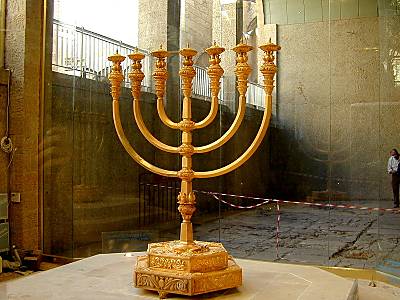
The menorah has seven branches and it is a candelabrum. It is lit by olive oil, although some now are electric. The menorah is one of the oldest Jewish symbols. It is supposed to symbolize the burning bush.
for more information:
picture from:
Sunday, October 14, 2007
Rabbi
A Rabbi is a religious leader of a Jewish congregation. Rabbis are spiritual leaders, educating and guiding their congregation, supporting anyone that is having trouble and answering religious questions. These days, the most common parts of a rabbi's job are preaching and officiating at ceremonies such as marriages, funerals, and bar or bat mitzvahs.
In the past however, rabbis served a much different role. Rabbis served in a judicial capacity in Jewish communities, resolving conflicts between people. Also, rabbis didn't lead any ceremonies or have congregations, instead they focused on studying and interpreting the Torah. Furthermore, there was a rule that rabbis weren't supposed to receive payment for their work, so most rabbis had a profession that they engaged in on the side.
Patai, Raphael. "Rabbi." Encyclopedia Americana. 2007. Grolier Online. 15 Oct. 2007 <http://ea.grolier.com.ezproxy.hclib.org/cgi-bin/article?assetid=0326920-00>.
In the past however, rabbis served a much different role. Rabbis served in a judicial capacity in Jewish communities, resolving conflicts between people. Also, rabbis didn't lead any ceremonies or have congregations, instead they focused on studying and interpreting the Torah. Furthermore, there was a rule that rabbis weren't supposed to receive payment for their work, so most rabbis had a profession that they engaged in on the side.
Patai, Raphael. "Rabbi." Encyclopedia Americana. 2007. Grolier Online. 15 Oct. 2007 <http://ea.grolier.com.ezproxy.hclib.org/cgi-bin/article?assetid=0326920-00>.
Thursday, October 11, 2007
Synagogue

The synagogue is where the Jewish community goes to worship. They also use the synagogue for a study and as a community center. In orthodox synagogues the men and women do not sit together. In a progressive synagogue the men and women can sit together. The synagogue services can either be lead by the rabbi or a member of the congregation.
for more information you can go here:
http://www.bbc.co.uk/religion/religions/judaism/worship/synagogue_1.shtml
for more information you can go here:
http://www.bbc.co.uk/religion/religions/judaism/worship/synagogue_1.shtml
Picture of the Jerusalem Synagogue in Prague is from About.com.
Bar and Bat Mitzvah

Bar Mitzvah meaning "son of commandment" and Bat Mitzvah meaning "daughter of commandment" is a tradition of the Jewish people. This tradition marks the transition between a child and an adult. Around the ages of 13 (12 by girls) the children are required to study the commandments. By the time of their bar or bat mitzvahs, it is assumed that they are fully aware and obligated of the commandments. There is usually a ceremony celebrating the day but is not required and was unheard of in the past. On the Saturday, shortly after the child's 13th or 12th birthday, they are called up to the Torah to deliver a blessing for the weekly reading. Now, it is common to see some congregations where the child reads the entire weekly Torah blessings or lead the service and they are normally required to make a speech, usually starting with "today I am a man." Afterwards some rabbis makes it mandatory for his students to sign an agreement starting they promise to live in the new life they have taken in and what they learned throughout the process.
For more information go to http://www.jewfaq.org/barmitz.htm
For more information go to http://www.jewfaq.org/barmitz.htm
Wednesday, October 10, 2007
Kosher
Kosher is a Hebrew term that translates to "fit," or "proper." The word is most commonly associated with the dietary restrictions observed by Orthodox Jews. Reform Jews typically do not consider these restrictions so important, and thus they usually don't observe them. However, the word can be used to refer to other things, such as certain objects used in rituals. The requirements for a food to be considered Kosher are that it isn't a type of animal that has been outlawed in the Torah, and, if it is another type of animal, that it has been killed properly. When the food is prepared, care must be taken to remove blood from any meat. This was done by putting salt on the meat to draw the blood out. In fact, Kosher Salt got its name from this practice, because its large crystals meant that it was well-suited to preparing Kosher meats, since the salt took longer to dissolve, drawing out more blood. Additionally, it is not Kosher to combine meat and dairy products, or to use the same utensils for both meat and dairy.
"Kosher." Encyclopædia Britannica. 2007. Encyclopædia Britannica Online Library Edition. 10 Oct. 2007 <http://www.library.eb.com.ezproxy.hclib.org/eb/article-9046106>.
"What is kosher salt?" Ask Yahoo. 2003. Yahoo. 10 Oct. 2007 <http://www.library.eb.com.ezproxy.hclib.org/eb/article-9046106%gt;.
"Kosher." Encyclopædia Britannica. 2007. Encyclopædia Britannica Online Library Edition. 10 Oct. 2007 <http://www.library.eb.com.ezproxy.hclib.org/eb/article-9046106>.
"What is kosher salt?" Ask Yahoo. 2003. Yahoo. 10 Oct. 2007 <http://www.library.eb.com.ezproxy.hclib.org/eb/article-9046106%gt;.
Subscribe to:
Posts (Atom)

